
The Behavioural Needs of Older Horses
As horses grow older and we reduce their work-load or retire them altogether, it is easy to lose sight of some of their behavioural needs. Or we might be aware of their changing needs but struggle to meet them when constrained by, for example, livery yards or herd structures.
Physical changes tend to be the most obvious. Horses may become stiffer as arthritis starts to take effect, needing longer to warm up (if still ridden) and restriction to slower gaits on hard ground. It may be harder for them to lie down, or roll, and stand up again, with implications for sleep patterns, bearing in mind that horses can only obtain full REM sleep when lying flat on the ground.
They may benefit from being barefoot, reducing concussion to their joints, provided they are comfortable. Enriching activities that may have entertained them when younger, such as play, may cease and they may spend considerably more time each day resting. However, despite these changing physical needs, there are still behavioural interventions we can make in order to ensure that our care of our older horses continues to meet their welfare needs.
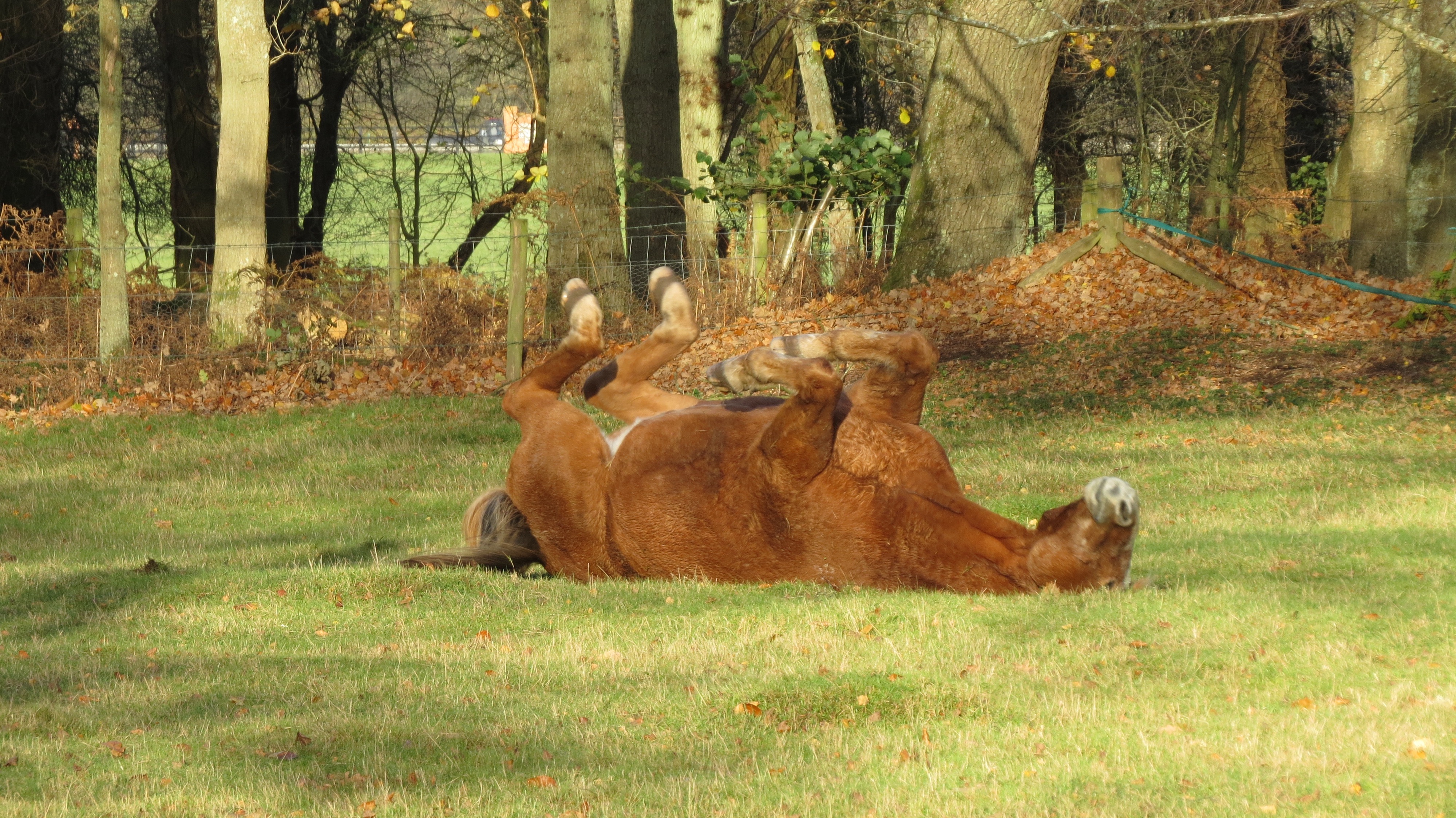 |
Fig. 1 - Still rolling age 27 |
Firstly we need to consider that, regardless of what we do with our older horses, most of us are not present for most of the day. What happens in those 23 hours a day that we are not spending time with them? Long hours of standing in a stable can exacerbate stiffness, particularly if coupled with hay in raised hay-nets. If the horse is out for all or most of the day then that is preferable, providing the field provides sufficient interest and equine companions. However, placing an older horse with any herd of horses can be problematic. Younger horses will want playmates and there is a risk that they would harass the older one. Even if not directly drawn into the play, if the herd is galloping up and down the field then desire to remain with the herd rather than alone will likely cause the older horse to try to keep up, regardless of physical cost. Thus having more sedate, older, well-socialised companions will increase your chances of providing the most stress-free existence.
There is also a risk that the older horse could become a target for bullying; changing herd dynamics and/or a poorly socialised herd member can lead to aggression, particularly around winter hay stations. Such problems can be overcome by a stepwise reintroduction program, with one or both of the two horses removed from the field and gradually re-acclimatised to one another across a fence. However it is also possible that the personality clash may persist and the horses need permanent separation and more suitable companions for each other.
Feeding is often a key concern for owners of older horses, with changes to dentition and/or reduced ability to obtain nutrients from the feed resulting in the need for dietary changes. An older horse may be less able - or unable - to eat hay, or even grass, particularly grass that is either long and hay-like or very short. While there are many mash feeds on the market these days, they do not address the horse's emotional need for free access to forage 24 hours a day, with grazing typically taking place for up to 16 hours a day. The horse's gut remains suited to 'trickle feeding', despite the state of the teeth, and so an ideal feeding regime will replicate the need for semi-continuous need for small amounts of food.
With play of less interest to older horses, sources of enrichment may need to be more feed-orientated. While sudden changes should not be made to a horse's diet, there is still plenty of scope for using a variety of different feed types - different chaffs with different grass mixes can be used to give more varied feeds. Feeds can be made up in multiple buckets with different components of the feed in each. In-hand walking can be a good way to give the horse a change of scene and chance to browse on a hedgerow. Browsing opportunities can also be provided in the field and stable, with addition of tree branches (e.g. oak, ash, poplar, willow, apple). Branches can also be smeared with herbal pastes to provide new scents and/or tastes to investigate. Further ideas for enrichment can be found at http://www.ebta.co.uk/faq-enrichment.html
| Fig. 2 - Provide variety with different forage feeds in different ratios in different buckets |  |
It is now well recognised that older horses can be prone to Pituitary Pars Intermedia Dysfunction (PPID), bringing with it increased risks of laminitis. Diagnosis is typically through blood test in order to determine whether the levels of adrenocorticotropic hormone (ACTH) are excessive. While high levels of ACTH can indicate PPID and the need for medication to reduce those levels of ACTH in the blood stream, they can also indicate some degree of stress; ACTH is released in response to stressors acting on the body, in turn triggering the release of cortisol. Attempting to reduce ACTH and cortisol through a stress-reduction program to ensure that the behavioural needs are met would be an important step towards helping your horse.
If medication for PPID is indicated then it appears that there can be certain side effects, known colloquially as 'the veil', in particular the loss of appetite and a depressed demeanour. Since these can also be symptoms of PPID itself, it can be hard to disentangle symptoms from side effect of the medication. However, there is alarge body of anecdotal evidence to suggest that a very gradual introduction of the medication can reduce these side effects (http://www.ecirhorse.org).
It is easy to create a 'must do' type of list for our older horses. But the reality of working with different equine personalities, different rules on different livery yards and different field set-ups means that putting all this into practice tends to be a horrible compromise that is coupled with lots of owner guilt. I recently had my 28 year old quarter horse, Jak, euthanised; he had been 'mine' for 22 years and the last 5 or so years had been difficult in terms of meeting his needs to the best of my abilities. So in the interests of sharing the sort of compromises I found worked for us I am providing a brief 'history' in the hope it may help. It doesn't remove the guilt; it seems that the nature of watching our beloved horses age and - to some extent - deteriorate will always cause us to feel guilty about our unavoidable imperfections. But it may help with thinking around the problems and inventing, at least partial, solutions.
- Jak lived out 24/7 in a herd of geldings, one close 'pair-bond' but happy with all other herd members, reasonably consistent herd for over 10 years.
- In later years he struggled to maintain his weight during late summer when the grass tended to be dry and grazed short but tended only to pick at the ad lib hay when provided in late autumn. I was providing additional feed but he was eating it in insufficient quantities to make much difference. I wanted to feed more but he needed to be able to 'graze' from forage replacement feeds and that meant time away from the other horses
- Arranged with the livery yard owner to use a separate field on alternate days during winter. That way he could have his bucket feeds and extra grass, hay and haylage (whatever I could tempt him to eat) in a field by himself (in view of other horses) one day but then return to his companions and ad lib hay the following day. This felt like a poor compromise, making him 'choose' between extra food or company but the best I could do at the time and I always took into account the field he appeared to choose. I varied the bucket feeds, splitting different components between them in different ways on different days. I was hoping to provide variety but he clearly preferred some mixtures to others so we gradually became more consistent. This worked for a few winters.
- Pair-bond horse was moved to new home. Jak's other main friend was being kept separate from the herd at the time so Jak kept him company. I was concerned about reintegration with main herd, which was imminent as this companion was also being moved to new home. But seemed better to keep him with his preferred companion and take each stage as it came.
- Second companion left and we attempted to continue with his alternating days, in the field with herd or alone with extra feed. Sadly my fears about reintegration were founded and he was badly bullied each time I tried to reintroduce him, despite spending time in field adjacent to the herd. Was given alternative companion in new field but had no shade and struggled with very hot weather. He also seemed very unhappy, presumably due to the loss of his closest friends. Made plans for a new home but had to wait a few weeks before could implement.
- Arranged new companion and field next to my house. Also had use of my
small field and garden for extra grass, lovely range of browsing plants and
mixed species grazing. Companion was laminitic Shetland so they had very
opposing needs but we managed to juggle. I was able to give Jak ad lib
forage replacement feed by feeding in buckets high on the fence where
Shetland couldn't reach (despite her best and sometimes successful efforts). Having access to a field shelter was very important to him and he would chivvy his companion to go there for naps at regular times each day.
His weight picked up beautifully and I even rode him for 20 minutes around
the block, once.
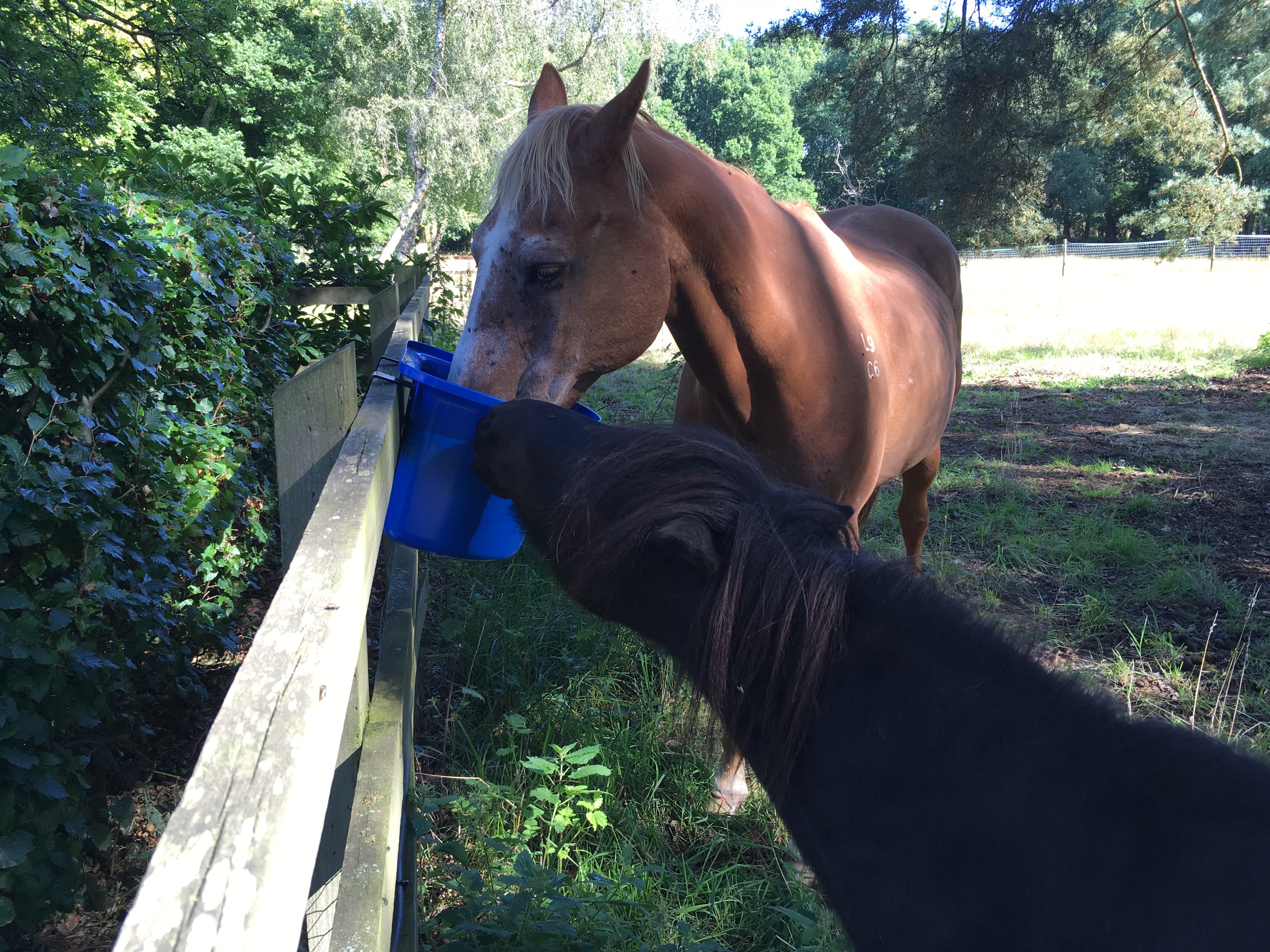
Fig. 3 - I felt bad for the Shetland but better than separating them (and she always managed to get something!)
- During the summer of 2018 the Shetland became footy and so needed restriction in a pen. While Jak's weight was doing well, the muscle tone over his hindquarters had reduced considerably since we had stopped ridden work and he had been moving less in the field since not being in a large herd. Spending time standing next to the pen may have contributed further to the weakening of his pelvis, or it may have been coincidental.
- During his last week he lay down next to the pen and became stuck. After a few hours and with the vet on the way he managed to stand but never regained normal mobility so, after discussions with vet and osteopath, sadly he was euthanised a couple of days later. I was so upset that we hadn't managed 'one last summer' together but, with the benefit of hindsight, I am now relieved as he would have hated the 2018 heatwave (in the UK) with its loss of lush grass and need for hay.
I hope this illustrates how meeting the older horse's needs is a changing process as they age and as circumstances change. It is so rewarding every time something seems to work and it feels though the horse will just keep on going for years. And then the emotional crash when something goes wrong, often something caused by external factors such as weather or livery yard rules. It is so easy to think that if I 'had just used that supplement' a year earlier, or 'had just booked a dentist appointment a little sooner' then things could have been different. But of course, we cannot predict all eventualities and, whatever we do, our beloved horses cannot live for ever. But we can give them a rewarding and enriched lives until the end of their days and allow them to go with a clear conscience.
Copyright Catherine Bell 2018